

The Journal of Strategic Innovation and Sustainability provides peer-reviewed research and case studies that bridge business strategy with environmental and social responsibility, offering tourism professionals evidence-based frameworks to design resilient, community-centered destinations. Published quarterly, this academic journal translates complex sustainability challenges into actionable strategic models, making it an essential resource for anyone transforming tourism from a short-term economic driver into a long-term catalyst for regional prosperity.
For those planning sustainable tourism initiatives, the journal delivers what policy documents and trend reports often miss: rigorous analysis of what actually works, why strategies succeed or fail, and how to measure impact beyond visitor numbers. Recent volumes spotlight collaborative governance models in coastal communities, innovation in low-carbon hospitality operations, and financial mechanisms that align stakeholder incentives with conservation goals. These aren’t theoretical exercises. They’re drawn from real destinations where strategic choices created measurable wins for local economies, ecosystems, and cultural preservation.
What sets this journal apart is its focus on the intersection of innovation and durability. Articles examine how destinations adopt new technologies, business models, and partnerships while maintaining the social and environmental foundations that attract visitors in the first place. You’ll find quantitative studies on revenue retention in local communities, qualitative research capturing resident perspectives on tourism development, and case analyses of regional coalitions that turned sustainability from a marketing claim into operational reality. The research consistently emphasizes one truth: sustainable tourism planning succeeds when strategy serves both competitive advantage and collective wellbeing, measured in jobs created, habitats restored, and cultural traditions supported rather than displaced.
What the Journal of Strategic Innovation and Sustainability Offers the Tourism Sector

The Journal of Strategic Innovation and Sustainability provides tourism professionals, researchers, and policymakers with a robust collection of peer-reviewed research that addresses the complex intersection of economic development, environmental stewardship, and social responsibility. Published quarterly by the International Academy of Business and Public Administration Disciplines, the journal prioritizes rigorous academic inquiry while maintaining practical relevance for industries navigating sustainability challenges.
Each issue features a mix of original research articles, conceptual frameworks, and detailed case studies that examine how organizations and destinations can achieve long-term viability without compromising ecological or cultural resources. The journal’s editorial board draws from multiple disciplines, business strategy, environmental science, public policy, and organizational behavior, ensuring that published work reflects diverse perspectives and methodologies.
For the tourism sector specifically, the journal covers:
- Strategic frameworks for destination management and resource allocation
- Innovation models that reduce environmental footprint while improving visitor experiences
- Stakeholder engagement processes that balance competing interests
- Measurement systems for tracking sustainability outcomes
- Policy analysis and regulatory approaches to sustainable development
- Technology applications for efficiency and transparency
The empirical research published in the journal often includes quantitative data from real tourism operations, occupancy rates, carbon metrics, community income distribution, visitor satisfaction scores, that help readers understand what strategies produce measurable results. Theoretical articles propose new planning models or adapt existing frameworks to tourism contexts, offering conceptual tools for rethinking how destinations develop.
Case studies document specific interventions, presenting detailed accounts of implementation challenges, resource requirements, and outcomes. These narratives provide valuable lessons from both successes and setbacks, helping tourism professionals anticipate obstacles and replicate effective approaches in their own contexts. The journal’s peer-review process ensures that published work meets academic standards for methodology and evidence while remaining accessible to practitioners who need actionable insights rather than abstract theory.
Strategic Planning Insights from Published Research
Frameworks for Balancing Economic Growth and Environmental Protection
The journal features planning models that help tourism stakeholders navigate the tension between profitability and environmental stewardship. One widely cited framework positions sustainability not as a constraint on growth but as a competitive advantage, destinations that protect their natural assets secure longer-term revenue streams by maintaining the landscapes and ecosystems that initially attracted visitors. Rather than viewing conservation as a cost, these models demonstrate how strategic resource management reduces operational expenses and builds destination resilience.
Published research highlights frameworks that integrate environmental thresholds into financial projections. For example, carrying capacity models help destinations determine visitor limits that preserve ecological integrity while optimizing revenue per visitor rather than sheer volume. These tools guide investment decisions toward infrastructure that generates economic value without degrading the environment, renewable energy installations, efficient water treatment systems and low-impact transportation networks that reduce operating costs over time.
The journal also documents adaptive management frameworks that allow businesses and destinations to adjust strategies as conditions change. These models incorporate feedback loops, monitoring environmental indicators alongside financial metrics, enabling planners to course-correct before irreversible damage occurs. By quantifying the economic risks of environmental degradation, these frameworks make the business case for protection clear to decision-makers who prioritize financial sustainability alongside ecological goals.
Community-Centered Tourism Development Models
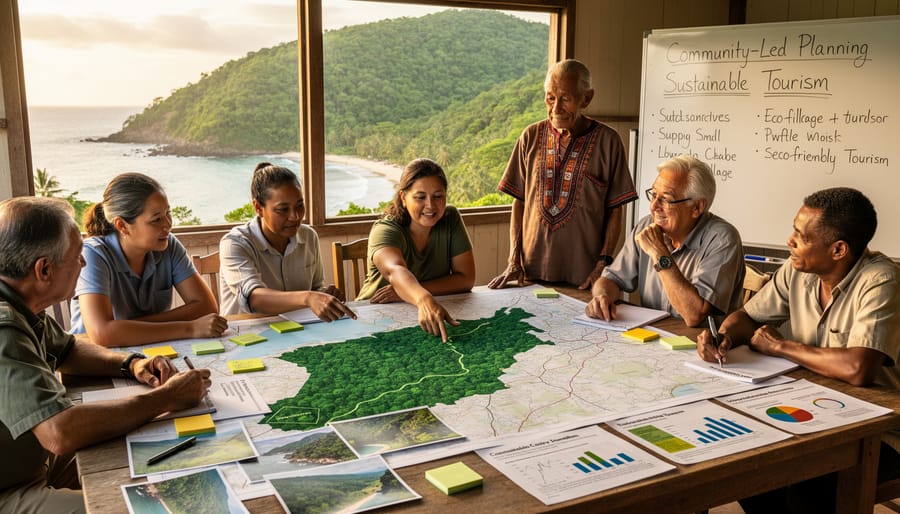
The journal consistently champions planning models that position local communities as decision-makers rather than bystanders. Research published in recent volumes demonstrates that sustainable tourism strategies succeed when they originate from within destination communities, incorporating resident knowledge, priorities, and cultural values from the earliest planning stages. These models challenge top-down approaches by establishing mechanisms for ongoing community input, shared governance structures, and transparent benefit-sharing agreements that ensure tourism revenue flows directly to local households and enterprises.
Several case studies featured in the journal illustrate how inclusive planning processes protect cultural heritage while creating economic opportunities. One framework documented in a 2025 publication outlines participatory mapping exercises where residents identify culturally sensitive sites, traditional practices requiring protection, and preferred tourism activities that align with community values. This approach addresses fundamental questions about who should lead tourism development initiatives and how power dynamics can shift toward equitable partnerships between external investors and local stakeholders.
The journal emphasizes measurement frameworks that track not just visitor numbers but community well-being indicators such as local employment rates, skills training participation, preservation of traditional knowledge systems, and resident satisfaction with tourism activity levels. Research shows that when communities control development pace and scale, they create more resilient tourism economies that withstand external shocks while maintaining social cohesion and cultural authenticity. These models demonstrate that tourism becomes a genuine development tool when communities define success on their own terms and retain authority over their resources, stories, and futures.
Real-World Applications: Success Stories and Case Studies

Research published in the Journal of Strategic Innovation and Sustainability moves beyond theory into documented transformation. The journal archives initiatives where destinations and businesses have implemented sustainable strategies with measurable outcomes, proof that well-designed plans deliver real environmental and social value.
A coastal municipality in Portugal leveraged frameworks from the journal to restructure its tourism economy around marine conservation. Working with local fishing cooperatives and dive operators, officials developed regulations that limited daily visitor numbers to sensitive reef areas while creating alternative income streams through sustainable aquaculture tours. Within three years, coral coverage increased by 23%, and community employment in tourism-related roles grew by 34%. The project, detailed in a 2025 case study, demonstrated how strategic limits on access can simultaneously restore ecosystems and strengthen local livelihoods.
In New Zealand, a regional tourism board applied collaborative planning models published in the journal to address overtourism at a popular hiking destination. Rather than simply restricting access, they worked with Māori iwi to create culturally guided experiences that redistributed visitors across a wider geographic area. The initiative reduced trail erosion by 41% on the most degraded paths while increasing indigenous-owned business revenue by NZ$2.8 million annually. The journal documented how centering community voices in planning created solutions that honored cultural protocols and protected fragile alpine environments.
A hotel chain operating across Southeast Asia used research on energy efficiency measures to redesign operations in seven properties. Implementing smart climate controls, LED retrofits, and solar thermal systems based on journal-published benchmarks, the company cut energy consumption by 38% across its portfolio and reduced annual carbon emissions equivalent to taking 1,200 vehicles off the road. Guest satisfaction scores rose as travelers increasingly chose accommodations with verified sustainability credentials.
The journal also tracks policy interventions. After Slovenia’s government reviewed multiple case studies on tourism taxation models, they introduced a graduated visitor fee that channeled funds directly into heritage site preservation and public transport expansion. Tourism revenue increased 12% while congestion at UNESCO sites decreased by 19%, an outcome attributed to strategic use of pricing mechanisms informed by academic research.
These examples share common threads: cross-sector collaboration, commitment to measurable targets, and willingness to adapt traditional business models. The journal doesn’t just report outcomes; it captures the planning processes, stakeholder negotiations, and implementation challenges that made success possible. For professionals designing their own initiatives, these documented experiences provide roadmaps that have already withstood real-world testing.
Practical Tools for Tourism Professionals and Policymakers

Tourism professionals and policymakers often struggle to translate academic research into practical action. The Journal of Strategic Innovation and Sustainability bridges this gap by offering concrete methodologies that inform how destinations and organizations build a sustainable plan. Published studies provide assessment matrices for measuring current performance against sustainability benchmarks, stakeholder engagement protocols that have proven successful in diverse contexts, and risk evaluation frameworks that help identify vulnerabilities before they become crises.
Many articles include detailed appendices with scoring systems for environmental impact, economic leakage calculations, and social equity indicators. A 2025 study, for example, presented a twelve-point checklist for coastal destinations balancing tourism growth with marine conservation, covering everything from waste management infrastructure to visitor education programs. Government officials have adapted these checklists to create regulatory standards, while private operators use them as internal audits to identify improvement areas.
Applying this research follows a logical progression:
- Identify your specific challenge or planning goal, whether reducing carbon footprint, increasing local employment, or protecting cultural sites.
- Search the journal’s archive for case studies or frameworks addressing similar contexts, using keywords related to your destination type and sustainability priorities.
- Extract relevant assessment tools, benchmarking data, or planning models from the methodology sections of applicable studies.
- Adapt these tools to your local context by involving community stakeholders in the customization process.
- Implement pilot programs or phased initiatives based on the research recommendations.
- Measure outcomes using the same metrics presented in the journal studies to enable direct comparison.
- Document your results and share them with your network to contribute to collective learning.
The journal also publishes comparative analyses that benchmark destinations against each other, providing valuable reference points. Tourism boards have used these benchmarks to justify funding requests, demonstrating how their performance measures against international standards. Small and medium-sized businesses benefit particularly from published best practices that don’t require large capital investments, operational changes in energy use, waste reduction protocols, and community partnership models that deliver measurable improvements within months. By grounding decisions in peer-reviewed evidence rather than untested assumptions, professionals reduce implementation risks and build credibility with investors, regulators, and communities alike.
Innovation Trends Shaping Sustainable Tourism in 2026 and Beyond
The Journal of Strategic Innovation and Sustainability serves as an essential compass for tourism professionals navigating rapid industry transformation. Recent publications reveal several converging trends that are reshaping how destinations and businesses plan for the future.
Technology-driven decarbonization dominates current research. Studies examine how electric aviation, hydrogen-powered ferries, and autonomous shuttle networks can reduce transport emissions without sacrificing accessibility. Digital platforms that match travelers with verified sustainable accommodations and experiences appear frequently, along with blockchain applications for transparent carbon tracking. Research also explores hotel energy management systems that use artificial intelligence to optimize consumption while maintaining guest comfort, demonstrating how smart infrastructure can deliver both environmental and economic returns.
Circular economy principles are moving from theory to practice in tourism planning. Published case studies show destinations eliminating single-use plastics through closed-loop systems, converting food waste into compost for local agriculture, and designing accommodations with modular components that extend building lifespans. These models prove that resource efficiency creates competitive advantages rather than constraints.
Regenerative tourism represents a shift beyond “doing less harm” toward actively improving destinations. Journal articles document projects where visitor activities fund wetland restoration, where tourism revenue supports indigenous language programs, and where accommodation construction enhances rather than degrades biodiversity. This approach redefines success: thriving ecosystems and empowered communities become performance metrics alongside occupancy rates.
Climate adaptation strategies receive growing attention as destinations face immediate risks. Research addresses sea-level rise responses for coastal resorts, water scarcity management in arid regions popular with tourists, and wildfire resilience planning for mountain destinations. These studies provide frameworks for maintaining tourism viability while protecting both visitors and residents from climate impacts.
The journal also tracks policy innovations, carbon pricing mechanisms for aviation, certification standards that prevent greenwashing, and international cooperation frameworks for transboundary conservation areas that support tourism.
By publishing cutting-edge research before trends become mainstream, the journal helps strategic planners anticipate challenges, identify opportunities, and position their organizations at the forefront of sustainable tourism innovation. These insights transform abstract concepts into concrete pathways forward.
How to Access and Use the Journal
The Journal of Strategic Innovation and Sustainability publishes content through Allied Academies, accessible through multiple channels depending on your needs and resources. Tourism professionals can find articles through the journal’s official website, where recent issues and individual papers are available. Many institutions provide access through academic database subscriptions like EBSCO, ProQuest, or JSTOR, making the journal readily available to university-affiliated researchers and students.
For practitioners without institutional access, the journal offers select open-access articles at no cost. Check the website’s archives for papers marked as freely available, which often include high-impact case studies and practical frameworks. Individual article purchases are another option when you need specific research for a project or planning initiative.
When searching for tourism-related content, use targeted keywords beyond “tourism” itself. Try “destination management,” “community development,” “environmental planning,” “stakeholder engagement,” or “cultural preservation” to uncover relevant strategic insights. The journal’s search function and annual indices help you locate papers addressing your specific challenges.
Do I need an academic background to use this journal?
No. While the journal publishes peer-reviewed research, many articles include executive summaries, practical implications sections, and case studies that translate findings into actionable strategies for industry professionals.
How often does the journal publish new content?
The journal releases issues quarterly, with each edition featuring multiple articles on innovation and sustainability topics relevant to tourism planning and other sectors.
Can I share journal articles with my team or stakeholders?
Sharing depends on your access method. Institutional subscribers can typically share within their organization, while purchased articles have specific usage rights detailed at download.
Focus on the implications and recommendations sections of academic articles first. These parts translate complex research into clear takeaways. Look for frameworks, assessment tools, and planning models you can adapt to your context. Many papers include tables, figures, and appendices with practical checklists or comparison matrices that serve as ready-to-use resources for strategic planning meetings and stakeholder workshops.
The Journal of Strategic Innovation and Sustainability stands as an essential bridge connecting groundbreaking research with practical action in sustainable tourism. By engaging with its peer-reviewed insights, frameworks, and case studies, tourism professionals, policymakers, and advocates gain the evidence-based tools needed to transform planning processes and deliver measurable environmental, economic, and social benefits. The collective knowledge shared through this journal empowers communities worldwide to shape tourism that regenerates rather than depletes, preserves rather than exploits. As the industry continues evolving, the research published here lights the path forward, proving that innovation and sustainability can thrive together. Your engagement with these resources strengthens the movement toward a travel industry that honors both people and planet for generations to come.